Cold storage operations require inventory control built around real warehouse activity: receiving, pallet labeling, lot tracking, catch weight, freezer storage, picking, shipping, customer inventory ownership, and billing.
Inspired Technology Systems provides cold storage warehouse software for food distributors, frozen storage facilities, refrigerated warehouses, meat processors, and 3PL cold storage operators.
The system tracks inventory by lot, pallet, customer, location, item, quantity, and actual weight, so warehouse teams can manage product movement from receiving through shipment without relying on spreadsheets or manual workarounds.
Built for Multi-Customer Cold Storage Warehouses
Food and frozen warehouses operate differently from traditional distribution environments.
Inventory is commonly shared across multiple customers, tracked by pallet and lot, stored in freezer locations, and billed based on actual warehouse activity.
Inspired Technology Systems was built for these operational requirements from the beginning.
The platform supports:
- customer-owned inventory
- pallet-level inventory tracking
- lot traceability
- catch weight products
- freezer warehouse management
- barcode scanning workflows
- automated storage and handling charges
- real-time receiving, picking, and shipping
The system combines warehouse management (WMS), inventory control, billing, and ERP functionality into a single ERP Software platform designed specifically for food and cold storage operations.
How Cold-Storage Inventory Moves Through Inspired ERP
Cold-storage receiving starts at the dock. The receiver records the customer, item, lot, pallet, quantity or actual weight, pack date, sell-by date, carrier, trailer, seal, and any temperature details that apply to the load.
When the receipt is complete, the warehouse assigns the product to a pallet and prints the label. The pallet is then put into a cooler, freezer, or other warehouse bin. Inspired ERP keeps the customer, lot, pallet, location, quantity, and weight attached to that inventory as it moves.
For outbound orders, warehouse staff scan the pallet and lot before completing the pick. Shipping updates the inventory record. If the operation bills for receiving, storage, handling, picks, or shipments, those activities are also available to the billing process.
The warehouse and office work from the same record instead of rebuilding the activity later from spreadsheets or paper.
Cold-Storage Workflows in Inspired ERP
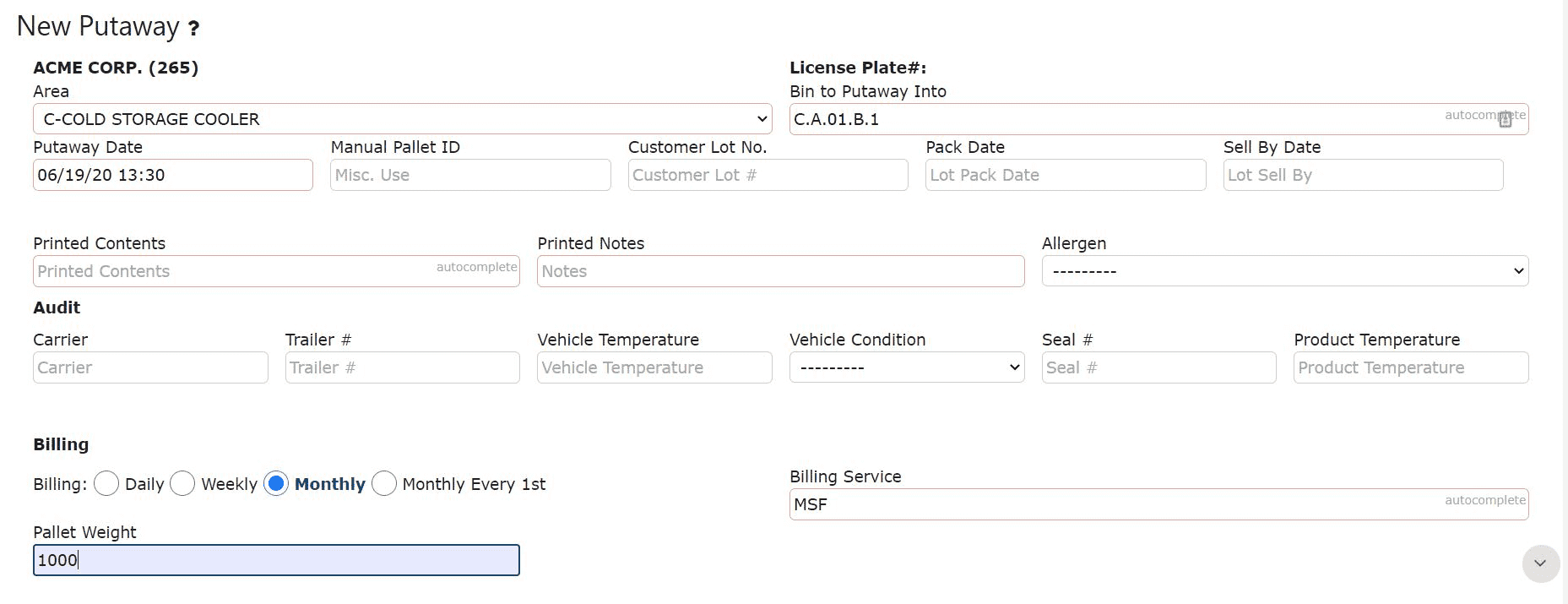
Receive and put away a weighted pallet
The putaway screen shown below is configured for a cold-storage cooler. It includes the destination bin, customer lot, pack and sell-by dates, carrier and trailer information, vehicle and product temperatures, billing frequency, billing service, and pallet weight.
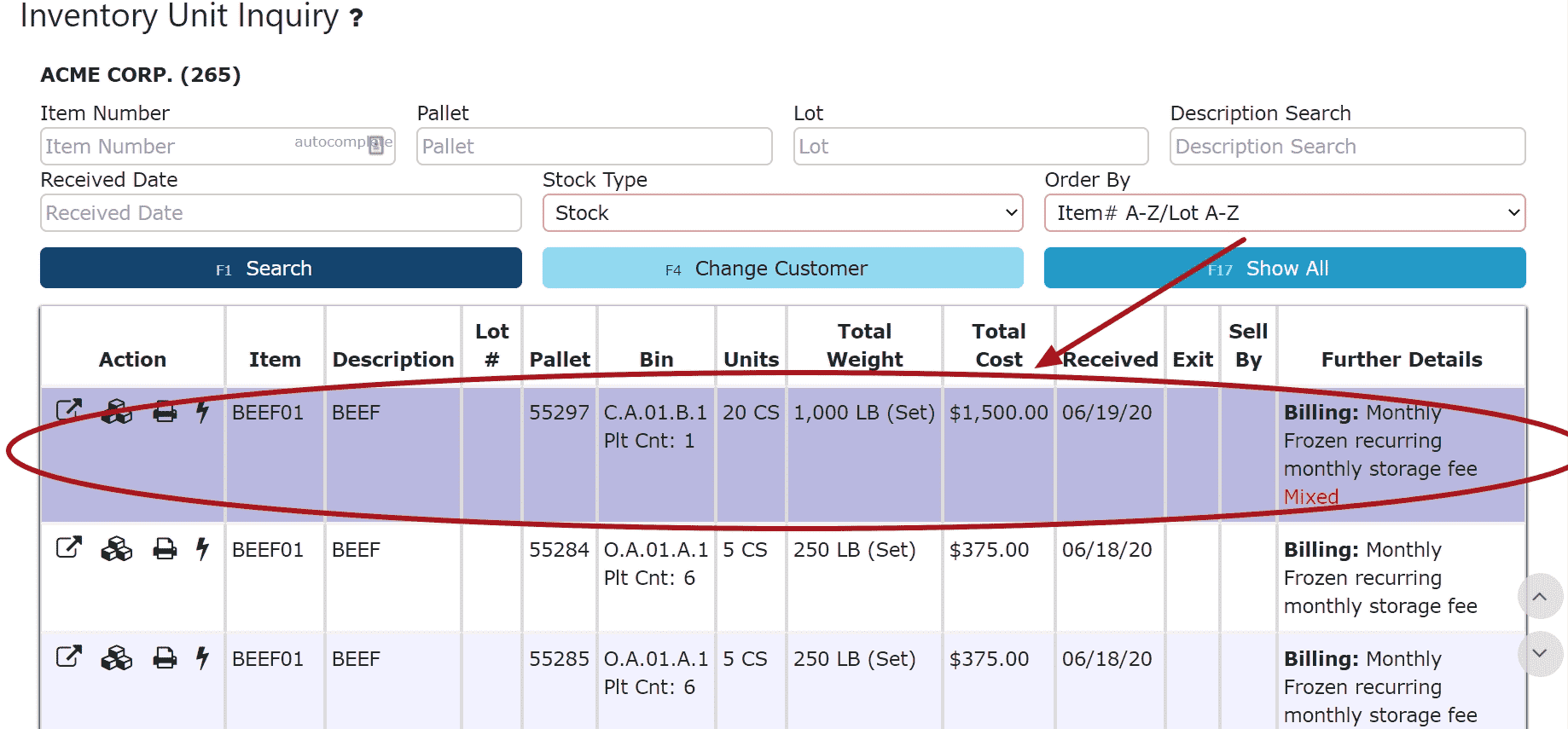
Find inventory by customer, lot, pallet, bin, or weight
The Inventory Unit Inquiry gives the warehouse one place to find a pallet and see its item, lot, bin, unit count, total weight, received date, cost, and storage-billing details.
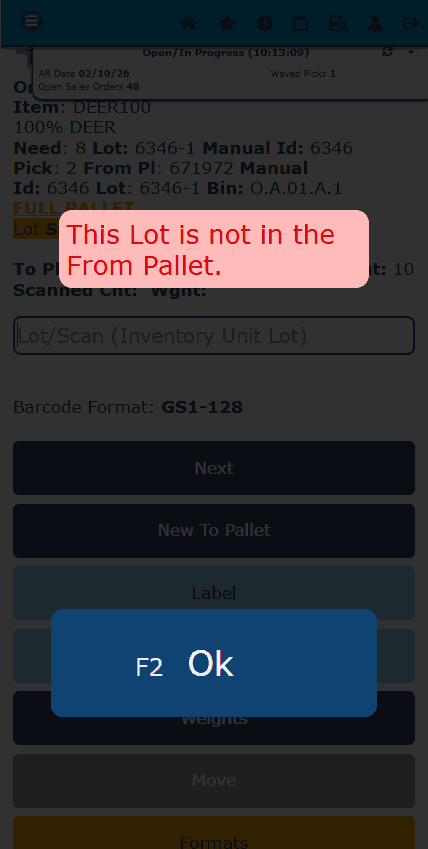
Stop a pick when the lot is wrong
When a warehouse user scans a lot that is not on the selected pallet, the handheld scanner stops the transaction and displays an error. The user must correct the lot or pallet before continuing.
Use warehouse activity for customer billing
The WMS Activity Billing screen sends recorded warehouse activity for the selected customer and billing cycle to Accounts Receivable. That connects the work performed in the warehouse to the customer's bill.

Built for Food, Frozen, and Meat Operations
Cold Storage operations require more than basic inventory tracking. This Cold Storage Software is built to handle weight variability, traceability, and compliance as part of daily warehouse activity, while also managing inventory by customer and supporting warehouse execution through scanning and labeling.
Within the warehouse, this means inventory is controlled in real time as it moves through your facility, from receiving through shipping.
Weight Variability
Products such as meat and seafood do not have fixed weights. The system tracks actual weight at receiving and carries that weight through picking, shipping, and billing.
This ensures inventory, pricing, and invoices are based on real product weight, not estimates.
During daily operations, warehouse users capture weights during receiving and picking, including through scan guns, reducing manual entry and improving accuracy.
Traceability
Inventory is tracked by lot from receipt through shipment. Each lot is tied to pallets, receipts, and outbound orders, allowing users to trace product movement at any point.
Inventory is also tracked by customer, ensuring product remains separated and identifiable in multi-customer warehouse environments.
Pallet labels can be printed at receiving and throughout the warehouse, showing key details such as item, lot, weight, and customer. Labels are designed to be clear and readable from a distance, with multiple formats supported based on operational needs.
Compliance
Cold Storage facilities must meet food safety and customer requirements for tracking and reporting. The system maintains accurate records of inventory, lot movement, and transaction history as part of normal warehouse activity. In a Cold Storage Warehouse Software setup, scan gun workflows can replace paper pick tickets, allowing users to pick, move, and verify inventory without printed documents if desired.
This supports audit requirements and customer expectations while reducing manual processes and improving consistency.
This system is part of a broader platform that includes ERP functionality, inventory management, and customer-facing portals, providing full operational visibility across the warehouse.
Inventory Management Built for Cold Storage
In Cold Storage operations, inventory is not just counted; it is weighed, labeled, and tracked by lot and pallet in real time.
Warehouse Inventory Tracking
Inventory tracking for frozen storage, refrigerated warehouses, food distribution, and multi-customer cold storage operations.
- Topography dashboard
- Pallet management
- FIFO, LIFO, or Lot support. We also allow specific pallet selection or by lot alone
- Label generation
- Catch Weights
- Multiple warehouse support
- Warehouse, area, bin, pallet, case-level management
- with history of activity at each level
- Moves can be entered just by scanning barcodes
- GS1-128 barcode processing
- Customer portal to see inventory & activity in real time
- Minimal training time for Scan Gun warehouse operators due to simplicity of RF guidance
Order Processing and Warehouse Fulfillment
Warehouse order processing for receiving, allocation, picking, shipping, and customer fulfillment operations within distribution ERP Software environments.
- Order Booking
- Order Planning
- Bin Reservations
- Storage and allocation charges: monthly, one-time, by count
- Order Changes
- Order Processing
- receive inventory
- stock inventory
- pick, pack, ship
- BOL generation
- Simple, clear, and bold pallet labels
- Bin Reservations
- Support SQF allergen requirements
- Order Demand
- shows what you'll need, to ensure you can fill future orders
Warehouse Billing and Invoicing
Automated billing based on warehouse activity, storage charges, handling, receipts, picks, shipments, and customer-specific pricing.
- Invoice generation from orders and warehouse data
- Custom service prices per customer
- Daily & monthly AR Batches
- Fail-safe EOD billing
- Automatic periodic service and per-activity billing based on warehouse activity
- Check status of orders and invoices in progress
- Resume upon error for the same batch
- Payment & Credit management
- Fully paperless capabilities, send documents to customers electronically
Order Demand
Shows what you'll need, to ensure you can fill future orders.
- lets customers track their inventory across future shipments
- lets customers know when to replenish stock into your warehouse to ensure timely and efficient fulfillment
- search for a particular item, or view all items at once
Equipment Management
You'll be inspired to care for your equipment.
- Equipment Management
- Preventative Maintenance
- Reactive Maintenance Tracking
- Meets SQF Level 2 standards and requirements
Mobile Friendly Design
Mobile-friendly and mobile-first design, according to your needs.
- Flexible and friendly design works even on older barcode-scanner handheld devices.
- Collapsing tables turn into display cards for mobile layout.
- Hotkeys available for speedy navigation & menu access - keep your fingers on the keyboard, do data entry at top speed, and make use of the physical buttons on your scanner guns.
Core Cold Storage Warehouse Capabilities
Lot Tracking
Inventory is tracked by lot number from receiving through shipment.
Each lot is tied to receipts, pallets, and outbound orders, allowing warehouses to trace product movement and customer shipments.
This supports recall management, audit requirements, and customer-specific traceability requirements.
Catch Weight Inventory
Products that vary in weight are tracked using actual pounds instead of fixed quantities.
The system records weight during receiving and maintains those weights through picking, shipping, billing, and reporting.
This supports meat, seafood, and other variable-weight food products.
Pallet-Level Inventory Tracking
Inventory is managed at the pallet level, including pallet contents, weight, location, lot information, and customer ownership.
Warehouse teams can move, allocate, and pick inventory directly by pallet throughout warehouse operations.
Automated Warehouse Billing
Storage, handling, receipts, picks, and shipments can generate billing automatically based on actual warehouse activity.
Customer-specific pricing and warehouse charges are calculated directly from operational transactions.
Cost Roll-Ups from Receipts
Costs entered during receiving, including product cost, freight, and additional charges, are rolled into inventory.
These costs carry through to reporting and margins, giving accurate financial visibility without separate calculations.
Accurate Tracking
With our advanced Cold Storage Software's Inventory Management System, you can precisely track your customer's product, down to the exact number of cases, pallets, lots, and inventory dates. This comprehensive system ensures optimal control and organization of your inventory.
Flexibility in Operations
Manage your customers as a traditional pallet-in/pallet-out operation, or act as their Full-Service Fulfillment Center. Sales orders can be picked on behalf of your customers, and you have the flexibility to bill them based on the number of cases picked, total weight, or the number of pallets pulled.
Customized Inventory Sequencing
To meet your customers' specific requirements, setup allows for their inventory to be automatically sequenced using FIFO, LIFO, or Lot methods.
Automated Email Notifications
Save time and effort by automating email notifications, including invoices and statements, configurable by customer. This automation allows you to focus on accuracy and exceptional customer service.
Real-Time Customer Access
Provide your customers with real-time access to their inventory, invoicing history, and even inbound/outbound reporting. Imagine giving your customers this ability! Set yourself apart from the competition, elevating your customer service and support -- while also automating it and freeing your time for other concerns.
Customer Inventory Visibility
Customers can access inventory, shipment activity, invoicing history, and inbound/outbound reporting through customer portal access.
The portal provides visibility into current inventory, receipts, shipments, and warehouse activity without requiring direct warehouse communication for routine inventory questions.
Warehouse Deployment and Operational Readiness
The platform is designed for rapid deployment within cold storage warehouse operations.
Warehouse teams can begin managing receiving, inventory movement, pallet tracking, lot traceability, warehouse billing, and customer inventory activity without lengthy customization projects.
The system supports:
- multi-customer warehouse operations
- pallet-level inventory tracking
- catch weight inventory
- barcode scanning workflows
- warehouse billing automation
- customer inventory separation
- SQF, USDA, and FDA operational requirements
Warehouse activity can be tracked by item, pallet, lot, customer, and location throughout receiving, storage, picking, and shipping operations.
Customer Portal and Inventory Visibility
Customers can access inventory activity, order status, shipment history, lot information, pallet details, and warehouse reporting through secure customer portal access.
The portal provides visibility into inventory movement and warehouse activity without requiring direct warehouse communication for routine inventory requests.